
The Accountability-to-Remedy Gap
Author(s): Fatoumata Kiné Niang Mbodji
Date: 21 April 2026
Country: Senegal
Language(s): English


French version here.
The historic coastal town of Bargny, located just 35 kilometers south of Dakar, is not merely an urban extension of the Senegalese capital. It is, above all, the sanctuary of a millennia-old Lebou culture and the beating heart of a centuries-old economy entirely oriented toward the Atlantic Ocean.
In this community, artisanal fishing is not merely one activity among many; it is the unshakable pillar of human, social, and spiritual existence, accounting for between 70% and 80% of the municipality’s economy. While approximately 20% of the male population engages in deep-sea fishing, the local economy is systemically dependent on this sector, whose revenues ensure the livelihood of over 40% of all residents.
At the center of this complex and vital system lies the Khelcom site, an essential workplace where thousands of women work as fish processors. These women, true guardians of food security and the financial pillars of their households, ensure the value-added processing of seafood and fuel the local economy. Yet, for over a decade, this social and economic lifeline has been stifled by the massive, looming shadow of the Sendou coal-fired power plant—an industrial project that has radically altered the community’s fate.
Seizing Land for a Coal-Fired Power Plant
The Sendou coal-fired power plant project, officially launched in 2009 at the government’s initiative to address Senegal’s chronic energy deficit, mobilized colossal amounts of international capital, promising modernization at the cost of a heavy local toll. This complex financing brought together several major institutions, notably the African Development Bank (AfDB) with a budget of €60 million, the West African Development Bank (BOAD) for €39.3 million, as well as the CBEAO for €14.8 million and the Dutch FMO for €35 million.
While the stated objective was public utility and energy sovereignty, the actual implementation on the ground took the form of systematic and brutal dispossession for the residents of Bargny. To build this massive infrastructure spanning 27 hectares, the Senegalese government invoked Law No. 76-67 (1976) regarding expropriation for public utility. This legal maneuver allowed the government to seize 1,433 residential plots from the community.
This land was not simply vacant lots awaiting development; it was a vital resettlement zone, the only hope for rehousing thousands of families already severely affected by rampant coastal erosion. Today, the situation is one of rare severity: these plots were seized from their owners without any prior, fair, or adequate compensation being paid, plunging residents into total uncertainty.
For the women processors at Khelcom, whose workspace is directly adjacent to the power plant’s perimeter, the problem extends far beyond the issue of land tenure alone. The 120 MW power plant, designed to run on coal, requires the combustion of approximately 386,000 tons of coal per year. Such industrial activity generates colossal annual net emissions, estimated at 964,554 tons of CO2 equivalent. As a historical comparison, this facility alone accounted for nearly 27% of Senegal’s total greenhouse gas emissions in 1995.
This massive pollution is not confined to the factory grounds: it spreads through the air, seeps into the soil, and contaminates wastewater. For fish processors, the consequences are immediate: ash and fine particles spoil the fish drying on racks, degrading product quality and reducing income. Even more seriously, constant exposure to these toxic fumes exposes women to chronic respiratory and skin diseases, while destabilizing the coastal marine ecosystem on which the very availability of the fish they process depends.
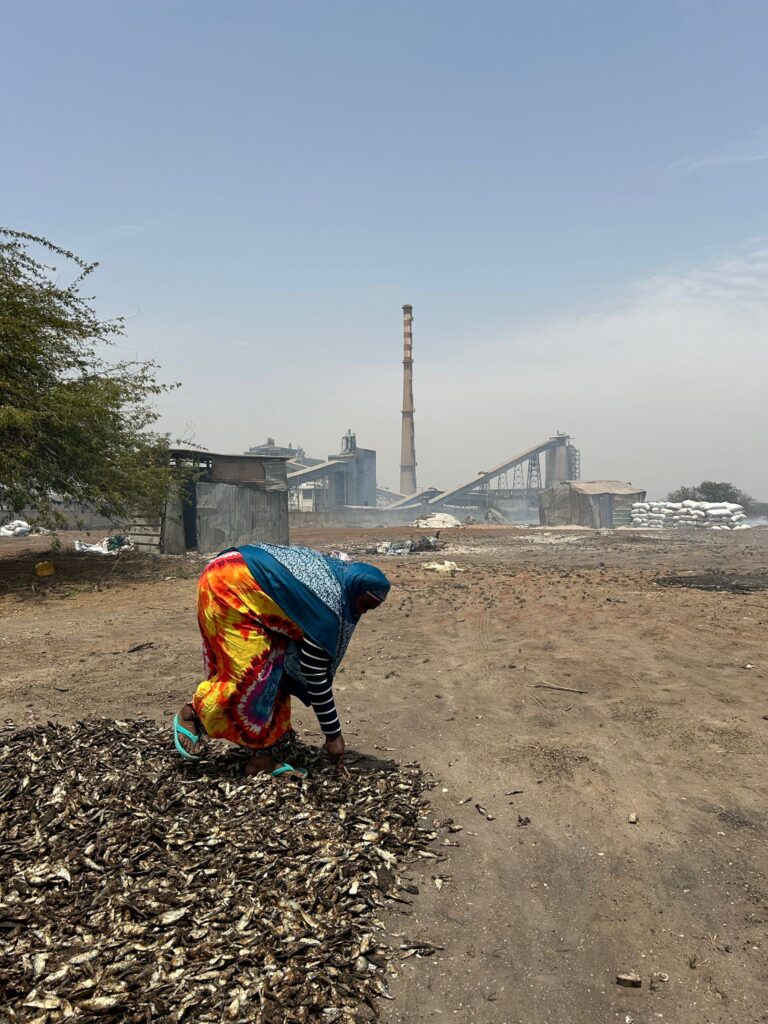 A fish processor in Bargny, with the Sendou plant in the background
(Credit: Fatoumata Kine Niang Mbodi)
Faced with this real threat to their environment, health, and livelihoods, the communities of Bargny, supported by the organization SynDev, formerly Lumière Synergie pour le Développement (LSD), have joined forces to demand accountability from the parties involved.
In May 2016, LSD filed an official complaint with the independent grievance mechanisms of the African Development Bank and the FMO. These mechanisms are not courts, but internal offices tasked with verifying whether the banks have complied with their own social and environmental standards when granting loans. After years of thorough investigations and field visits, these bodies officially acknowledged major non-compliance issues. In 2019, the AfDB published a damning audit report confirming that rules protecting local communities had not been applied, which forced the institution to approve a corrective action plan. Since 2020, progress reports have been published regularly to track progress. The women of Khelcom have become true guardians of this process, participating in every inspection mission to bear witness to their reality.
Ten Years Between Accountability and Remedy
Yet, despite this institutional acknowledgment of the mistakes made, tangible change is still a long time coming. This is where what we call the “Accountability-to-Remedy Gap” crystallizes. This ten-year delay corresponds to the transition from adolescence to adulthood for an entire generation that, during this period of administrative inertia, has seen its social fabric permanently altered. The structural decline in the incomes of women fish processors has broken the mechanisms of intergenerational solidarity, as families are no longer able to finance the education or integration of young people. This precariousness, exacerbated by a lack of interest in fishing trades now perceived as unhealthy due to the power plant’s influence, is driving a growing proportion of young people toward illegal emigration. In the world of development finance, this paradox is an open wound: communities are exhausting their resources to obtain official recognition of the harm they have suffered, yet this recognition fails to trigger concrete action, while people’s life trajectories are permanently shattered by the wait.
Far from healing this human divide, the institutional process has further deteriorated with the announcement on April 25, 2025, of the sale of all FMO loans to Kebe Capital, a private company. This withdrawal from the project by the FMO, presented as responsible, actually constitutes a major failure in the chain of accountability. By withdrawing financially before resolving the grievances raised in the 2016 complaint, the FMO is abandoning the communities to their fate in the face of a private buyer who, unlike development banks, is not subject to any public accountability policies or independent recourse mechanisms. The investor thus exits the scene without providing any guarantee of lasting remediation, leaving behind unfinished corrective measures. The June 2025 follow-up mission can therefore no longer be a mere formality; its forthcoming report must denounce this avoidance strategy, in which the “post-withdrawal diligence” invoked by the banks risks remaining a theoretical concept if no pressure is exerted to transfer the initial commitments in a binding manner to the private sector.
Two Inseperable Pillars of Reform
To put an end to this situation of impunity, where acknowledgment of wrongdoing never leads to the restoration of rights, I propose two inseparable pillars of reform.
The first pillar is based on prevention through the right to say no. To prevent the litigation cycle from beginning, it is imperative to transform the current system of mere “consultation”—often reduced to a retroactive administrative formality—into an obligation to achieve results. We denounce the obsolescence of current methods for validating Environmental and Social Impact Assessments (ESIA), which do not require the consent of the majority of the affected population to be validated. Furthermore, while respecting the sovereignty of states, it is unacceptable that, in the context of public projects, the client can produce its own impact studies without rigorous and independent oversight by the bank. Financial institutions have robust safeguard systems on paper, but their application is rendered meaningless when the project proponent is both judge and party. We therefore advocate that Free, Prior, and Informed Consent (FPIC) become a binding eligibility requirement, restoring the sovereign value of the people’s “NO” and forcing banks to assume their supervisory role from the design phase onward.
The second pillar constitutes the lever for redress through financial conditionality. Since the Sendou case demonstrates that compliance audits are insufficient to compel actors to act, we must move toward systemic sanctions. We advocate for strict conditionality on all new financing granted by Multilateral Development Banks (MDBs). Specifically, no state or private-sector enterprise should be able to apply for new loans from these institutions until a serious dispute over a Category 1 project has been resolved to the satisfaction of the complainants. This “credit freeze” mechanism is the only one capable of transforming theoretical accountability into effective reparations: by preventing access to new capital and prohibiting project exits until the liability is settled, it prevents the “reparations debt” from being diluted or transferred to private entities such as Kebe Capital.
The Sendou case reveals a structural failure in the safeguards of MDBs: the inability to translate findings of non-compliance into tangible remedial measures. This “accountability-to-remedy gap” exposes a brutal power imbalance in which the institution validates its own failures through audit reports, without restoring the violated rights of communities. In Bargny, this institutional inertia acts as a multiplier of precariousness, accelerating the breakdown of the social fabric and driving young people to leave. The struggle for climate justice in Khelcom can no longer be satisfied with endless mediation processes. It demands a radical reform of the banks’ operational frameworks so that remediation becomes a legal and financial obligation, not a discretionary option. As long as “development” remains synonymous with unpunished dispossession of communities, it will continue to pose a direct threat to local resilience. The credibility of international institutions is at stake here: in their ability to move from the rhetoric of law to the reality of reparations.
ABOUT ACCOUNTABILITY KEYWORDS
Key terms in the accountability field often have different meanings, to different actors, in different contexts – and in different languages. The Accountability Keywords blog addresses “what counts” as accountability, analyzing the meanings and usage of both widely used and proposed “accountability keywords”. It draws on dialogue with dozens of scholars and practitioners around the world. The blog has a related, extensive Accountability Working Paper and more than 40 posts that reflect on meanings and usage of relevant keywords in their own contexts and languages. To share a post about a keyword that interests you, send us a proposal at arc@american.edu.
AUTHOR INFORMATION

SHARE THIS BLOG