
“Wantam”: Kenyans’ Slang for Just One Presidential Term, and Why it Matters
Author(s): Idah Knowles
Date: 27 February 2026
Country: Kenya
Language(s): English


Author’s Note
This accountability keyword blog analyzes the circulation of “WanTam” as political language and its implications for incumbency norms and democratic accountability in Kenya. It does not endorse any political actor, slogan, or campaign position. It treats WanTam as a case study in how political language travels across elite contestation, digital culture, and institutional response.
From Nickname Politics to Accountability Keywords
Kenyan politics has long relied on nicknames and slang to register public judgment about power-holders. Through them, citizens express approval, disappointment, attachment, and fatigue, often outside formal institutional channels or official narratives. For example, one such term is Zakayo. Barely two years into office, President William Ruto’s public moniker shifted from Hustler to Zakayo, a Swahili reference to the biblical tax collector Zacchaeus. The nickname gained traction amid 2024 protests against the government’s taxation agenda, particularly the Finance Act, which raised levies on fuel, housing, salaries, and basic goods. For many Kenyans, these measures translated into rising living costs, business closures, job losses, and intensified tax enforcement. Zakayo condensed these experiences into a moral critique of a presidency widely perceived as economically challenging. The nickname endured because it captured how the president and his policies were experienced in everyday life.
Source: 254 news
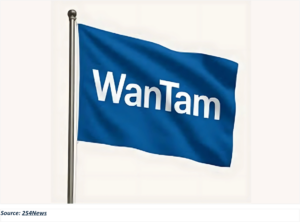
A new word, WanTam, marks a shift away from personalized slang about power-holders toward broader questions of incumbency. Derived from the phrase “one term,” it entered the vernacular in May 2025 during a Democracy for Citizens Party (DCP) rally, where then Deputy President Rigathi Gachagua publicly framed the presidency as potentially limited to a single term. Although initially articulated during elite contestation, the phrase quickly moved beyond its original speaker into protest spaces, online forums, and informal organizing discourse.
Unlike Zakayo, which moralizes governance, WanTam invokes Kenya’s constitutional principle of term limits and reframes politics around time, renewal, and conditional legitimacy.
Kenya’s Historical Legacy of Incumbency
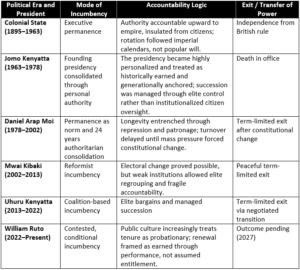
Kenya’s presidential system and authority have historically rested on inheritance, entitlement, elite bargaining, and carefully managed and negotiated succession—within ruling coalitions, party structures, and political families. It is within this history that WanTam becomes legible, as it does not emerge out of a vacuum but pushes against a long-standing assumption that incumbency carries an automatic claim to renewal.
The table below traces how successive political eras in Kenya have structured incumbency and constrained accountability, highlighting what WanTam disrupts, and why its timing matters now.
Uptake and Practice of WanTam: Who Uses the Word and How it Circulates
Understanding WanTam requires looking beyond definition to use: through repetition and response it has become embedded in music, contested across regions, enacted through performance, socially enforced and politically policed—moving beyond protest into culture, identity, and regional politics, where it shapes behavior, triggers state counter-strategies, imposes reputational costs, and reorganizes how loyalty and accountability are signaled in public life. The sections below show how this works in practice.
A perfect fit for digital culture. Digital platforms did much of the work of spreading WanTam. On YouTube, TikTok, and X, it spread through short clips, memes, and comments tagged #WanTam, often with no explanation at all. People especially Gen Z users were not writing long captions at all: A national budget headline announcing a new tax? WanTam. A photo of a pothole that has outlived several administrations? WanTam. A media outlet tweet of a new levy notice? WanTam. A clip of a politician laughing mid-speech? WanTam. In each case, WanTam appears as a one-word response.
The word works because it is brief, flexible, and easy to repeat. It travels quickly across unrelated moments, allowing users to attach a shared sense of political dissatisfaction to events they interpret as mismanagement or indifference. Over time, repetition broadens its meaning, hence, what began as a precise critique of tenure became a shorthand for accumulated frustration. In digital culture, where saying less often says more, WanTam’s power lies in how easily it can be reused, adapted, and understood without saying much. Beyond memes and hashtags, the term also appears in citizen-led digital accountability experiments that document service delivery gaps and governance grievances. The significance lies less in the apps or tools themselves than in the shift toward evidence-backed public narration of performance.
From elite contestation to broader uptake. As WanTam spread beyond rallies and timelines, political actors attempted to organize around it. The slogan gained visibility during elite contestation within the ruling coalition, particularly following the public rift between then Deputy President Rigathi Gachagua and President William Ruto, where it was framed as a one-term verdict on the administration. However, its subsequent circulation extended beyond intra-elite rivalry, taking on meanings not confined to party strategy. One illustration of this dynamic occurred when Cleophas Malala, deputy leader of Gachagua’s new party the DCP, urged dissatisfied opposition MPs to formally join a “WanTam movement” aimed at limiting Ruto to a single term. He pointed to their absence from a broad-based Parliamentary Group meeting in Karen and their continued criticism of the government over alleged abuses against Gen-Z protesters as evidence that they were already aligned with the WanTam position.
Delegitimation and the struggle over who gets to say the word. As WanTam began to gain traction, one response from those opposing it was to discredit the term by discrediting its speakers. Pastor Victor Kanyari, a well-known televangelist with a large national following, argued during a sermon that WanTam was a chant used only by maskini (poor people), whom he portrayed as angry, envious, and unfairly blaming President Ruto for their economic situation. Online critics pushed back, rejecting the idea that WanTam was merely “maskini talk” and pointing instead to its use across workplaces, neighborhoods, cultural spaces, and social media.
Denying scale and revealing it. Attempts to confine WanTam to the Mount Kenya area where it was coined were openly made by figures close to the administration. In June 2025, President Ruto’s photographer, Naitwa Mwangi, dismissed the chant as a Mount Kenya and social-media phenomenon, urging critics to “check the ground.” Mwangi’s dismissal did not land quietly but triggered a wave of ridicule and correction. “I’m a Rift Valley guy, and on the ground we’re singing one term,” one user wrote. Another joked that even his grandfather was now a member of the “WanTam Worship” choir. Others brushed off the claim with dry humor, responding “We are the ground” and “Tell them the ground is different.”
The reorganization of politics around time. WanTam evolved into a paired political grammar, with the rise of its counter-slogan TuTam. As noted by constitutional lawyer Willis Otieno, contemporary Kenyan politics has increasingly been framed through competing slogans such as “WanTam” and “TuTam,” a development he argues risks displacing substantive policy debate. Across rallies and media commentary, incumbents and first-term officeholders began answering the call for “one term” with an assertion of continuity, TuTam, often stretched into kumi bila break (“ten without a break”)──a colloquial way of claiming two uninterrupted terms in office. Martha Karua (the deputy running mate of presidential candidate Raila Odinga in the 2022 general election) captured this logic from the opposite direction when she declared, “It is possible to lay a foundation and allow the next team to build on it. I am seeking one term—one people, one purpose, one term.”
Performance and cultural overwrite. WanTam showed its force when it entered public performance. In May 2025, a popular Kenyan musician led a crowd in chanting “WanTam” during a live concert. Days later, he appeared publicly with a senior government official and soon after aligned himself with TuTam, thereby President Ruto’s second term. Some fans interpreted the shift as indicative of political pressure and reacted by withdrawing support and criticizing him publicly. The state, in turn, began promoting TuTam through musicians and cultural figures, using access and visibility as incentives for public alignment, trying to overwrite WanTam’s popularity by cultural means.
When power is forced to answer. When WanTam reached State House, President William Ruto responded by placing it in the lineage of earlier campaign chants. At a rally, he grouped it with slogans such as “Tibim” and “Tialala,” suggesting it was simply another round of political noise that would be dealt with during the formal election season. Elsewhere, he rejected the label directly, stating, “I will not allow anybody to define me in terms of time, terms, and elections,” and warning that his government would not “succumb to the blackmail and threats of WanTam.” He later described WanTam and “Ruto Must Go” as “wash wash politics” — a Kenyan expression implying something fraudulent or unserious, seeking to recast both as empty sloganeering rather than substantive political critique.
Source: The East African
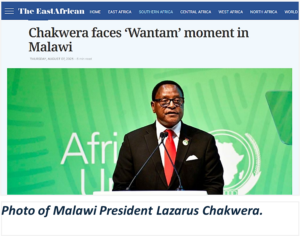
Regional spread and when a word becomes a concept. The portability of WanTam is clearest in its migration beyond Kenya. Regional media described Malawi’s President Lazarus Chakwera as facing a “WanTam moment,” using the Kenyan term as shorthand for the plausibility of electoral non-renewal. Here, WanTam ceased to be only a Kenyan story and became shorthand for a broader pattern in which, as public patience thins, continuity is no longer assumed.
Lexical consolidation and how WanTam survives scrutiny. By the end of 2025, WanTam had crossed a decisive line: it was no longer confined to rallies or brushed aside by leaders, but was being widely searched and absorbed. Google’s Year in Search listed WanTam among Kenya’s top trending “meanings” of terms people were trying to understand. Around the same time, Commissioner Danvas Makori of the National Cohesion and Integration Commission(NCIC) clarified that WanTam, and its counter TuTam, fell squarely within legitimate political expression. This normalization has not neutralized the terms but repositioned them within ongoing electoral contestation. To date, both are deployed by competing actors to mobilize support and signal alignment ahead of the 2027 general elections. Whether WanTam ultimately translates into electoral change remains uncertain. What is analytically significant is its reframing of incumbency as contingent rather than automatic, signaling evolving public expectations about performance, renewal, and democratic accountability in Kenya.
ABOUT ACCOUNTABILITY KEYWORDS
Key terms in the accountability field often have different meanings, to different actors, in different contexts – and in different languages. The Accountability Keywords blog addresses “what counts” as accountability, analyzing the meanings and usage of both widely used and proposed “accountability keywords”. It draws on dialogue with dozens of scholars and practitioners around the world. The blog has a related, extensive Accountability Working Paper and more than 40 posts that reflect on meanings and usage of relevant keywords in their own contexts and languages. To share a post about a keyword that interests you, send us a proposal at arc@american.edu.
AUTHOR INFORMATION

SHARE THIS BLOG