


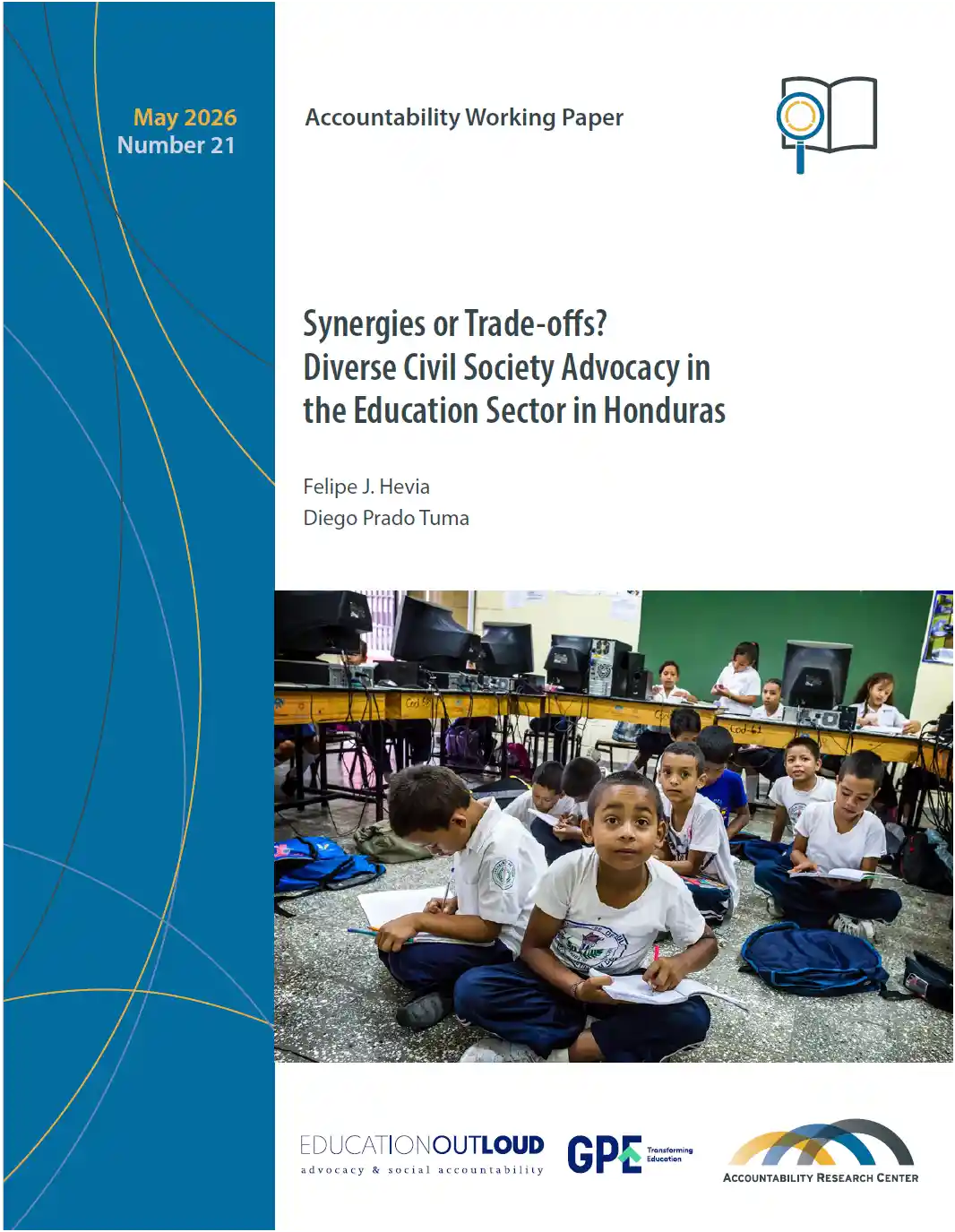
Synergies or Trade-offs? Diverse Civil Society Advocacy in the Education Sector in Honduras
Date: May 2026
Author(s): Felipe Hevia and Diego Prado Tuma
Publication type: ARC Accountability Working Paper
Published by: Accountability Research Center
This Working Paper uses the case of Honduras to examine the role of civil society organizations (CSOs) in education systems in contexts of limited state capacity. Given such a context in Honduras, we argue that creating a more equitable and high-quality education system requires a strategic alliance between two types of civil society actors that are typically separate.
On the one hand, there are ‘established’ actors, defined as organizations that defend the right to education, often through funding from international organizations. On the other hand are ‘emerging’ actors, defined as organizations focused on improving the quality of education through the implementation of specific projects, and funded by private companies.
The paper argues that a strategic alliance between these two perspectives would allow for a more comprehensive articulation of demands for quality and equity in education, generating synergies around the strengthening of public education systems. It discusses a rare example of such coordination, the case of early childhood policy, and reflects on how organizations dedicated to policy advocacy can advocate for quality education, not just for access to school.
For this strategic alliance to exist, the paper argues that it necessary to recognize existing obstacles that include the lack of a common agenda; mistrust and political differences; and disputes over funding.
Key takeaways include:
· The right to education and the implementation of educational improvement projects are interdependent dimensions of a comprehensive systemic transformation of public education in Honduras.
· Individual projects yield positive results, but require a broader vision that includes the human rights agenda and the right to education to create pathways for scaling up.
· The evaluative framework of monitoring laws, funding, and institutional processes used by established actors lack the financial and technological power of projects to improve educational quality.
· Thinking collectively about promoting the right to education and the implementation of educational improvement projects is necessary to strengthen the public education system in Honduras.
Felipe J. Hevia holds a Ph.D. in Anthropology from CIESAS-DF and has been a professor and researcher at CIESAS-Golfo since 2009. He is a member of the Mexican Academy of Sciences and the National System of Researchers. His research focuses on political anthropology and educational research. He has been a visiting professor at the University of Chile (2018), University of Seville (2025-2026), and an Antonio Madero Visiting Fellow at the David Rockefeller Center for Latin American Studies at Harvard University (2022–2023). He has been co-coordinator of the MIA program since 2014 and is the author of more than 100 publications, including articles, book chapters, and books.
Diego Prado Tuma holds a Ph.D. in Educational Research from the Universidad Veracruzana, where he conducted research on school discrimination from the perspectives of school climate and justice theory. He is a secondary school teacher and independent researcher and resides in Xalapa, Veracruz. His research interests include educational institutions, equity policies, and qualitative methodology.