


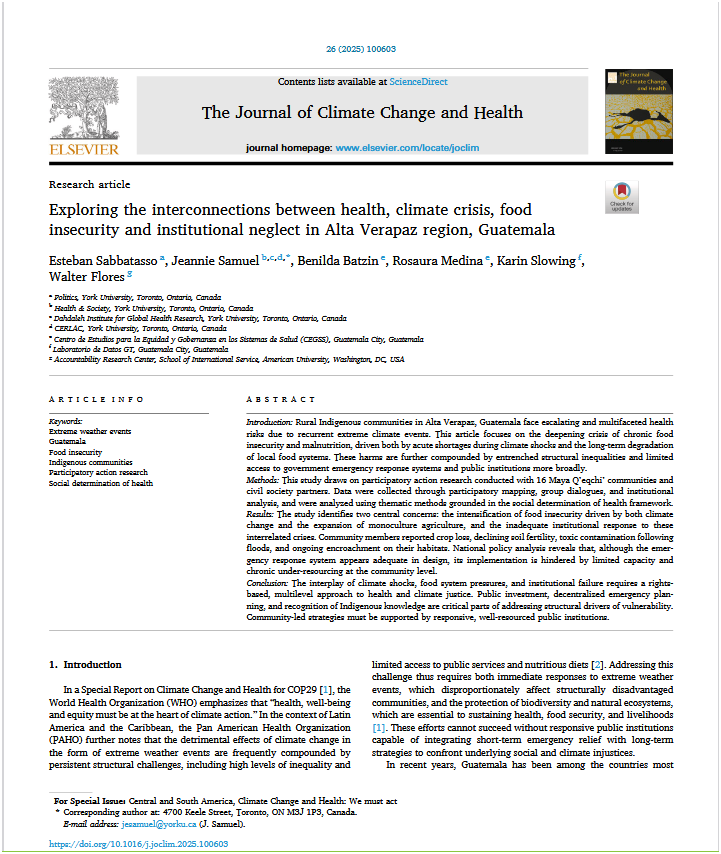
Exploring the Interconnections between Health, Climate Crisis, Food Insecurity and Institutional Neglect in Alta Verapaz Region, Guatemala
Date: December 2025
Author(s): Esteban Sabbatasso, Jeannie Samuel, Benilda Batzin, Rosaura Medina, Karin Slowing, Walter Flores
Publication type: Scholarly journal article
Published by: Journal of Climate Change and Health
Rural Indigenous communities in Alta Verapaz, Guatemala face escalating and multifaceted health risks due to recurrent extreme climate events. This article focuses on the deepening crisis of chronic food insecurity and malnutrition, driven both by acute shortages during climate shocks and the long-term degradation of local food systems. These harms are further compounded by entrenched structural inequalities and limited access to government emergency response systems and public institutions more broadly.
This study draws on participatory action research conducted with 16 Maya Q’eqchi’ communities and civil society partners. Data were collected through participatory mapping, group dialogues, and institutional analysis, and were analyzed using thematic methods grounded in the social determination of health framework.
The study identifies two central concerns: the intensification of food insecurity driven by both climate change and the expansion of monoculture agriculture, and the inadequate institutional response to these interrelated crises. Community members reported crop loss, declining soil fertility, toxic contamination following floods, and ongoing encroachment on their habitats. National policy analysis reveals that, although the emergency response system appears adequate in design, its implementation is hindered by limited capacity and chronic under-resourcing at the community level.
The interplay of climate shocks, food system pressures, and institutional failure requires a rights-based, multilevel approach to health and climate justice. Public investment, decentralized emergency planning, and recognition of Indigenous knowledge are critical parts of addressing structural drivers of vulnerability. Community-led strategies must be supported by responsive, well-resourced public institutions.
Jeannie Samuel, Health and Society, York University, Toronto, Ontario, Canada; Dahdaleh Institute for Global Health Research, York University, Toronto, Ontario, Canada; and CERLAC, York University, Toronto, Ontario, Canada
Benilda Batzin and Rosaura Medina, Centro de Estudios para la Equidad y Gobernanza en los Sistemas de Salud (CEGSS), Guatemala City, Guatemala
Karin Slowing, Laboratorio de Datos GT, Guatemala City, Guatemala
Walter Flores, Accountability Research Center, American University, Washington DC, USA